

Revolutionary design for temporary security fencing
What makes The De-Fence System so unique?
The key design features of The De-Fence system are as follows:
-
100 metres of assembled ‘De-Fence System’ weighs approx. 5 tonne.
-
The fence height is 2400mm metres in height
-
The roller or spike insertions in the top of the fence frame extend the fence height 2515mm
-
Gripping points have been removed to restrict the ability to climb.
-
Spinning rollers or spikes also remove the ability to grip.
-
2 metre dry moat to navigate by guard patrols
-
ATV access possible through moat via ATV gates at the rear of the fence
-
Hostile Vehicle mitigation

Security Design Elements

Panels and mesh
Unauthorised entry is predominantly caused by climbing fences. The ‘anti-climb mesh’ has been specifically used due to its lack of gripping points.

Footings
The two-metre-long footings stabilize and interlock the fence panels. High winds have no impact on the fence due to the systems modular design and the assembled weight of the entire perimeter.

Brace bar
The ‘De-Fence System’ has the capability to impact vehicle attack or crashing at the fence line. Security spikes can be hammered into the ground through the holes at the end of the footings.

System durability
The steel construction and integrated assembly provides a durability far beyond current temporary fencing. It is estimated the ‘De-Fence System’ could be in circulation for 10 – 15 years before replacement is required

Roller insertions
Unauthorised entry is predominantly caused by climbing fences. The rollers on the ‘frame insertion bars’ spin independently, should they be grabbed. The frame insertion is positioned to restrict the top of the panel being gripped.

Spike insertions
The Spike insertions are the replacement to rollers, having the effect of barbwire.

Front roller joiner
A fully assembled ‘De-Fence’ perimeter consists of dual panels, front and rear. The fence is interlocked with footings and joiners to ensure a single solid barrier. Further the system is of steel construction. 100 metres of interlocked fence weighs approximately 5 tons.

Portability
The ‘De-Fence System’ dimensions allow for the components to be stored and transported in sea containers. Forklifts can be used to transfer the system from storage to flatbed trucks and transport to site for assembly.

Rear joiner
Further stabilising of the structure is achieved through the rear joiner. This piece is quickly and easily installed and assists in strengthening the panels and alignment.

Corner panel
These specific panels and footings are used to navigate any angles and/or corners occurring in the area to be secured.

Manual assembly
The ‘De-Fence System’ is manually assembled without the use of machinery. Manual labor is all that is required to erect the system. No different from the current inadequate portable fencing systems

Personnel gate
The second fence or rear fence line has intermittent personnel access gates. These give access to security personnel to support moat patrols. There is also an ATV or small vehicle access gate for larger sites to patrol the perimeter within the dry moat. The width of the moat allows for smaller mobile vehicles.

ATV gate
An ATV access gate is also optioned for bigger sites where foot patrol is not sufficient. Perimeter patrols can be conducted by vehicles no wide than approx 1490mm. Two vehicles with terrain tyres can also be used. Show photo of ATV gate and then ATV driving through the moat.
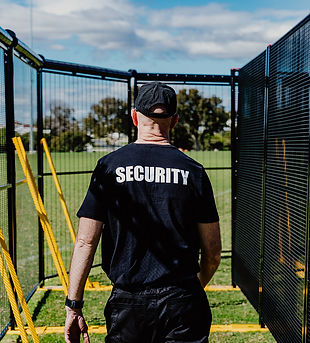
Supports Personnel
The system supports security operatives along with safety of personnel and patrons with the 2.4 metre front panel and insertions creating a steel barrier when patrolling along the dry moat.